
 6 min read
  21st July, 2026
Every year, people across England, Scotland and Northern Ireland buy an estimated 25 billion drinks in single use containers, plastic bottles, steel cans and aluminium cans among them. Of those, around 6.5 billion are never recycled. That works out at more than 17 million containers wasted every single day.
Those numbers show up on the ground in a familiar way. Drinks bottles and cans are consistently among the most common items found in England’s litter surveys, and, according to Keep Britain Tidy’s research, when the public is asked which type of litter bothers them most, drinks related packaging tops the list.
This is not a new problem. Households across the UK have had access to kerbside recycling collections for decades. Yet recycling figures have barely moved. That gap between effort and outcome is what the Deposit Return Scheme (DRS), due to launch across England, Scotland and Northern Ireland on 1 October 2027, is designed to close.
Why kerbside recycling has not been enough
England’s household recycling rate has sat at about 44 to 45 percent for a decade. Government figures describe the rate as having flatlined since 2015, well below the 50 percent target originally set for 2020. Two issues sit behind that plateau.
The first is inconsistency. Different councils have historically collected different materials in different ways, so an item accepted for recycling in one area could be rejected as contamination in the next. The Government has described this as a postcode lottery, and closing it is the specific aim of the separate Simpler Recycling reforms now being rolled out alongside DRS.
The second is contamination itself. Recent research from WRAP found that 81 percent of people put at least one item in their recycling that their council does not accept locally. Too much contaminated waste material can prevent a whole lorry load of material from being recycled.
Kerbside collection was also never well suited to drinks consumed away from home. A can finished at a bus stop or a bottle emptied in a park rarely makes it back to a household bin. It becomes litter instead, which is one reason Keep Britain Tidy estimates that around 16 million plastic bottles fail to enter the recycling system in England every single day.
What a deposit actually changes
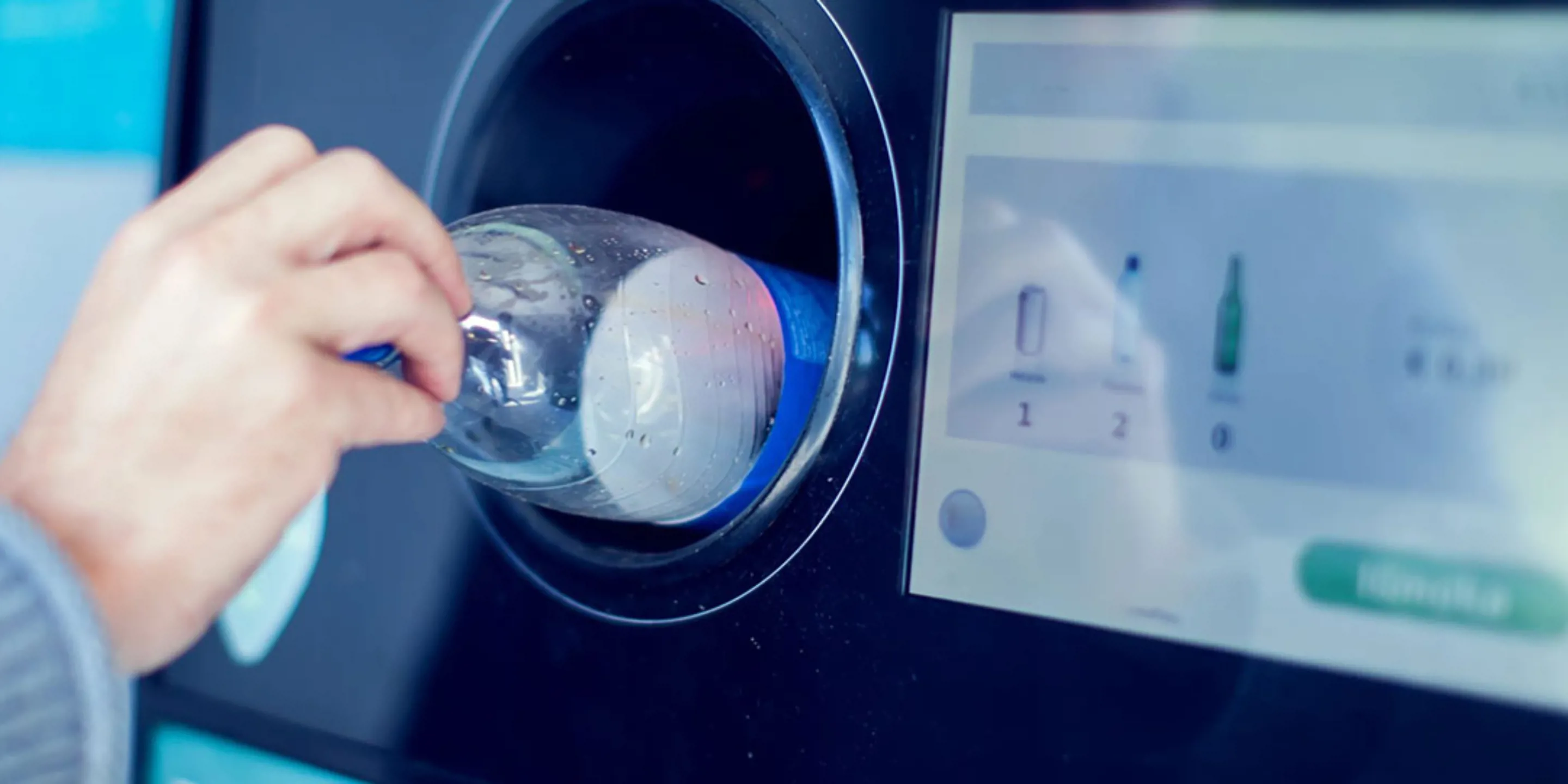
A deposit return scheme works on a simple piece of behavioural logic. Right now, an empty bottle or can has no value. Once the drink is finished, it becomes rubbish, something to be disposed of.
A refundable deposit changes that arithmetic. Exchange for Change, the organisation appointed to run the scheme, will introduce a flat deposit of 20p per in-scope container. The moment that charge is added, the container stops being rubbish and becomes something with a price attached to it. It is similar to the glass bottle return scheme that peaked from the 1950s to the 1970s, only applied consistently, at national scale, and backed by dedicated collection infrastructure rather than habit or goodwill. Recycling stops depending on someone remembering to use the right bin. It becomes something people actively choose to do, because there is now a reason to.
What the evidence from outside the UK shows
The clearest test case for how well this works in practice is Ireland’s Re-turn scheme, which launched in February 2024. Before the scheme began, Ireland recycled roughly 49 percent of in-scope plastic bottles and cans. According to Re-turn’s own reporting, that figure had risen to an estimated 91 percent within about a year and a half of operation, with 76 percent of containers captured directly through the scheme itself.
The impact on litter has followed a similar pattern. Re-turn reports that container litter has fallen by more than half since launch, contributing to the cleanest Irish beaches recorded in 25 years.
Reloop, which works with governments, industry and society to accelerate the global transition to a circular economy, reports that 18 mature deposit return schemes across Europe have a median collection rate of 90 percent, with over half of the countries achieving recycling rates of 90 percent or higher.
European examples are not a perfect comparison. Deposit levels, existing infrastructure and consumer habits all differ from the UK’s. But behavioural shifts of that scale, in such a short timeframe, are difficult to dismiss.
Part of a wider shift
Litter reduction is the most visible argument for a deposit scheme, but it sits inside a larger policy direction. Alongside DRS, the UK is introducing Simpler Recycling and extended producer responsibility for packaging reforms, both aimed at keeping materials in circulation rather than losing them to landfill or incineration after a single use. The Government has been explicit that these reforms together are intended to support the move towards a more circular economy.
A drinks container returned through a deposit scheme tends to produce cleaner, higher value material than one sorted from general household waste, because it has not been mixed with other rubbish along the way. That matters, because material of that quality can go back into new packaging rather than being downcycled or lost from the system entirely. It is the same principle behind most of the circular economy work Greenzone supports clients with day to day, keeping materials useful for as long as possible, rather than treating them as waste the moment they are finished with.
A lot to take in at once
None of this is landing in isolation. Many businesses are already working through Simpler Recycling and extended producer responsibility for packaging, and a Deposit Return Scheme is now arriving in the same fairly tight window. It is entirely reasonable to feel that it is a lot to keep track of at once.
Understanding why DRS exists, and why the evidence so far suggests it will work, is a useful starting point. Working out exactly what it means for your business is a separate conversation, and one we are always happy to have. Speak to the Greenzone team if you would like any further assistance with it.
Sources
- Defra, Introducing the deposit return scheme for drinks containers (annual container and waste figures)
- GOV.UK, Deposit Return Scheme: drinks producer and retailer responsibilities (legislative basis and October 2027 launch date)
- GOV.UK, Simpler Recycling in England: policy update (flatlined recycling rate, postcode lottery)
- GOV.UK, Simpler household recycling rules come into force across England (circular economy framing)
- WRAP, Recycling Tracker survey in the UK: Spring 2025 (contamination rate)
- Keep Britain Tidy, A Rubbish Reality: our litter problem and why it matters (public perception of drinks litter)
- Keep Britain Tidy, Recycling (16 million plastic bottles a day)
- Exchange for Change, official site (proposed 20p deposit level, scheme administrator)
- Re-turn, 2024 Annual Report (49% to 91% recycling rate)
- Re-turn, homepage (litter reduction and beach cleanliness figures)
- Reloop, Global DRS performance factsheet
Streamline your waste today
Book in a free waste audit to see how we can support your journey to sustainable waste management.


 Contact
 Support Hub
 Customerzone